Creative Vision and Multimedia Lab (CMLab), Chung-Ang University, South Korea Efficient Neural Computing Lab (ENC Lab), Kyung Hee University, South Korea
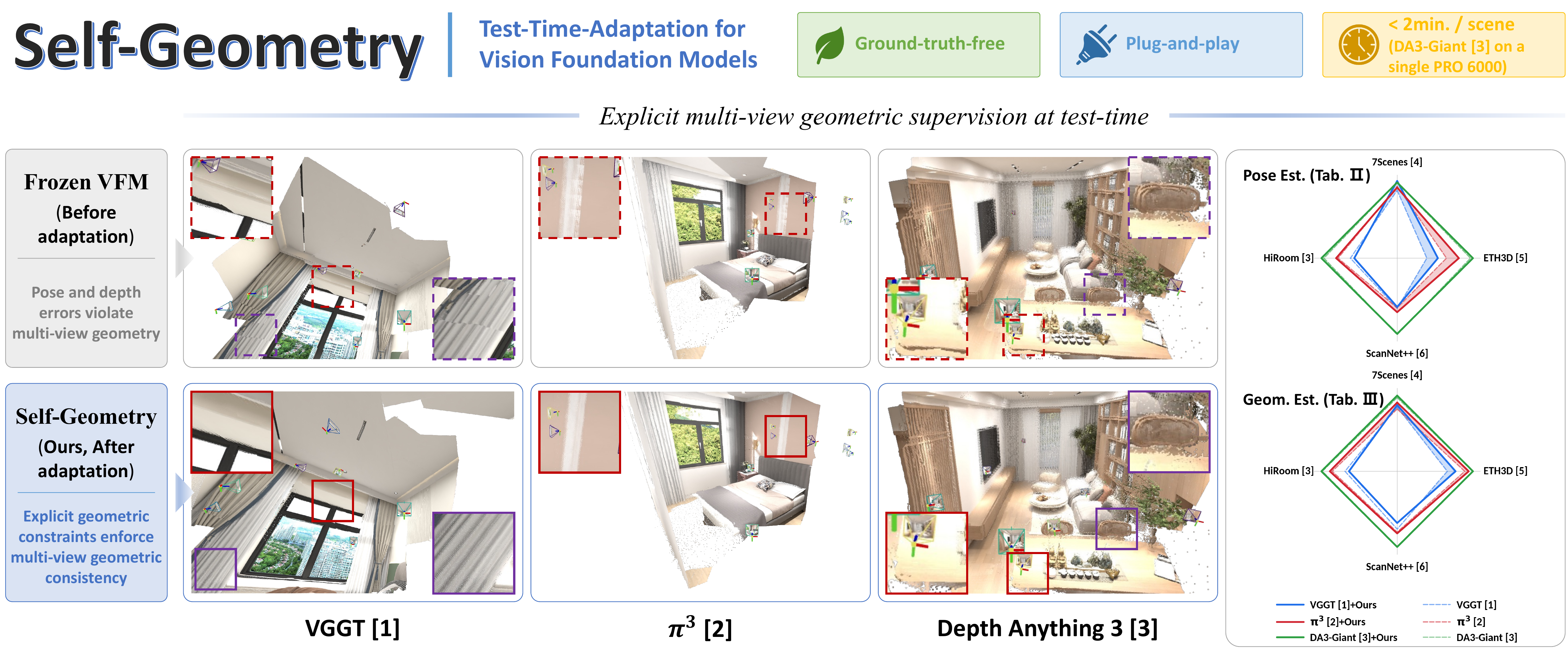
Self-Geometry is a GT-free and plug-and-play
test-time adaptation pipeline that imposes explicit multi-view geometric constraints on pretrained
3D VFMs (VGGT, π3, DA3) by using 2D pixel correspondences as pseudo GT. It delivers
consistent improvements in both Pose Estimation and Geometry Estimation
across six VFMs and four benchmarks within
two minutes per-scene.
Overview
Abstract
Recent Vision Foundation Models (VFMs) predict depth, camera pose, and pointmap in a single forward
pass without per-scene optimization, achieving strong generalization. However, enforcing explicit
multi-view geometric consistency, e.g., through bundle adjustment, is computationally costly and is
thus not imposed during VFM pretraining, so such inconsistency can arise. To address this, implicit
self-consistency derived from model outputs (e.g., pointmaps, features), though enforced at test-time
in prior work, delivers inherently limited performance gain, especially on scenes where the pretrained
VFM is highly inaccurate. In contrast to this implicit signal, we propose Self-Geometry, a
plug-and-play test-time adaptation pipeline that directly imposes explicit multi-view geometric
constraints using 2D pixel correspondences as pseudo ground-truth. Our proposed Self-Geometry
consists of Geometric Disentanglement Optimization, which combines Multi-View
Consistency and Epipolar Consistency losses with Gradient Disentanglement to prevent gradient
conflict; Frame Angular-Neighbor, a view sampler based on SO(3) geodesic distances
for lightly imposing these constraints; and Lightweight TTA, which adapts VFMs via
LoRA. Our method achieves consistent improvements in both pose and geometry estimation across six
VFMs (VGGT, π3, DA3-Giant/Large/Base/Small) and four benchmarks (7Scenes, ETH3D,
ScanNet++, HiRoom).
Fig. 1. Overview and representative results of our proposed Self-Geometry,
a plug-and-play TTA pipeline that imposes explicit multi-view geometric constraints
on pretrained VFMs, yielding consistent Pose and Geometry Estimation gains across
diverse pretrained VFMs (VGGT, π3, DA3-Giant/Large/Base/Small) and
four benchmarks (7Scenes, ETH3D, ScanNet++, HiRoom).
Interactive Demo
Interactive Examples
Drag the slider to compare each pretrained VFM's baseline reconstruction
against the one adapted by our Self-Geometry.
Top row: pointmaps. Bottom row: depth maps.
Motivation
Why Explicit Geometry?
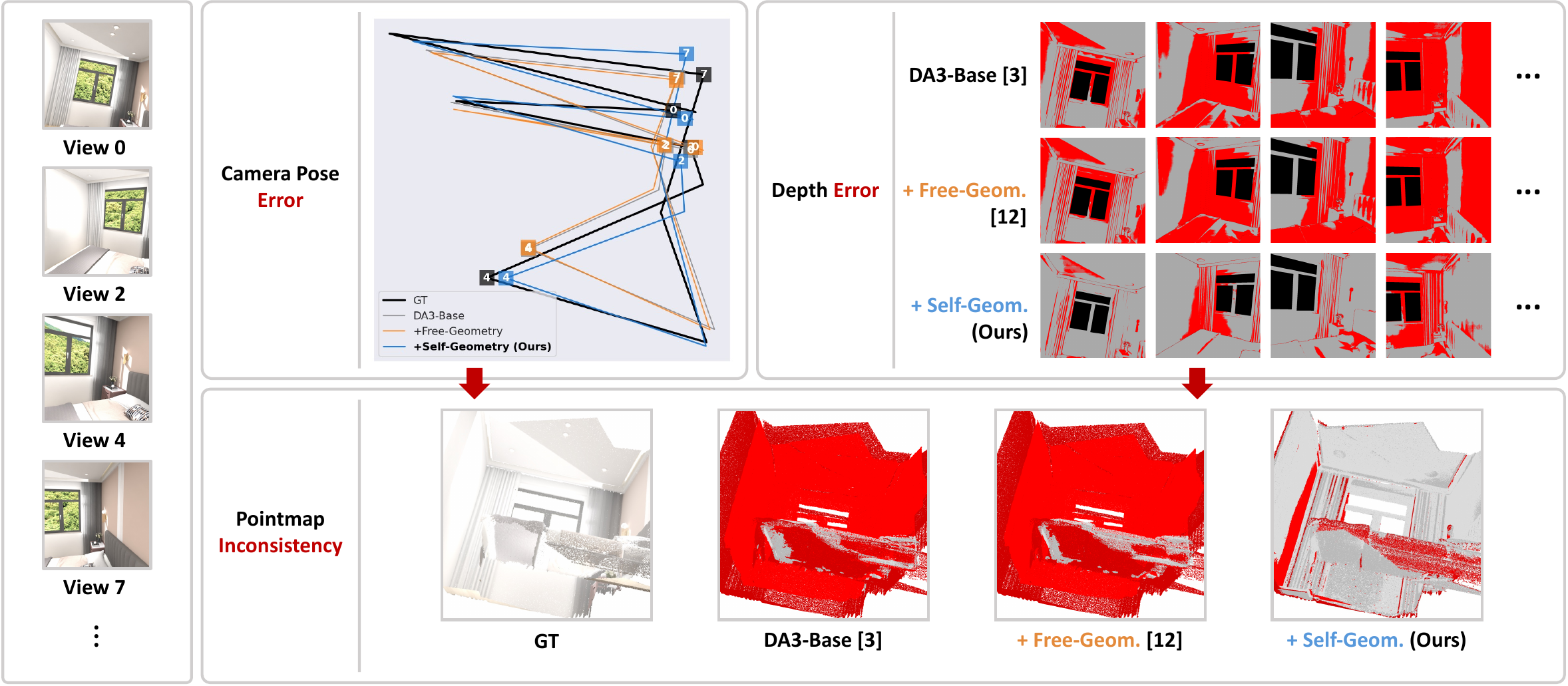
Existing implicit self-consistency methods barely improve where the pretrained VFM is most inaccurate.
We adapt the model with explicit multi-view geometric constraints instead.
Fig. 2. Comparison on a HiRoom scene (828786), decomposed along
camera pose error, depth error, and the resulting pointmap. Free-Geometry, a representative
implicit self-consistency method, fails to substantially improve pose and depth, giving
only limited pointmap improvement. Our proposed Self-Geometry, which directly imposes
explicit multi-view geometric constraints, delivers consistent improvements across all three.
Red = errors above the benchmark threshold;
gray = correctly reconstructed pixels.
Method
Self-Geometry Pipeline
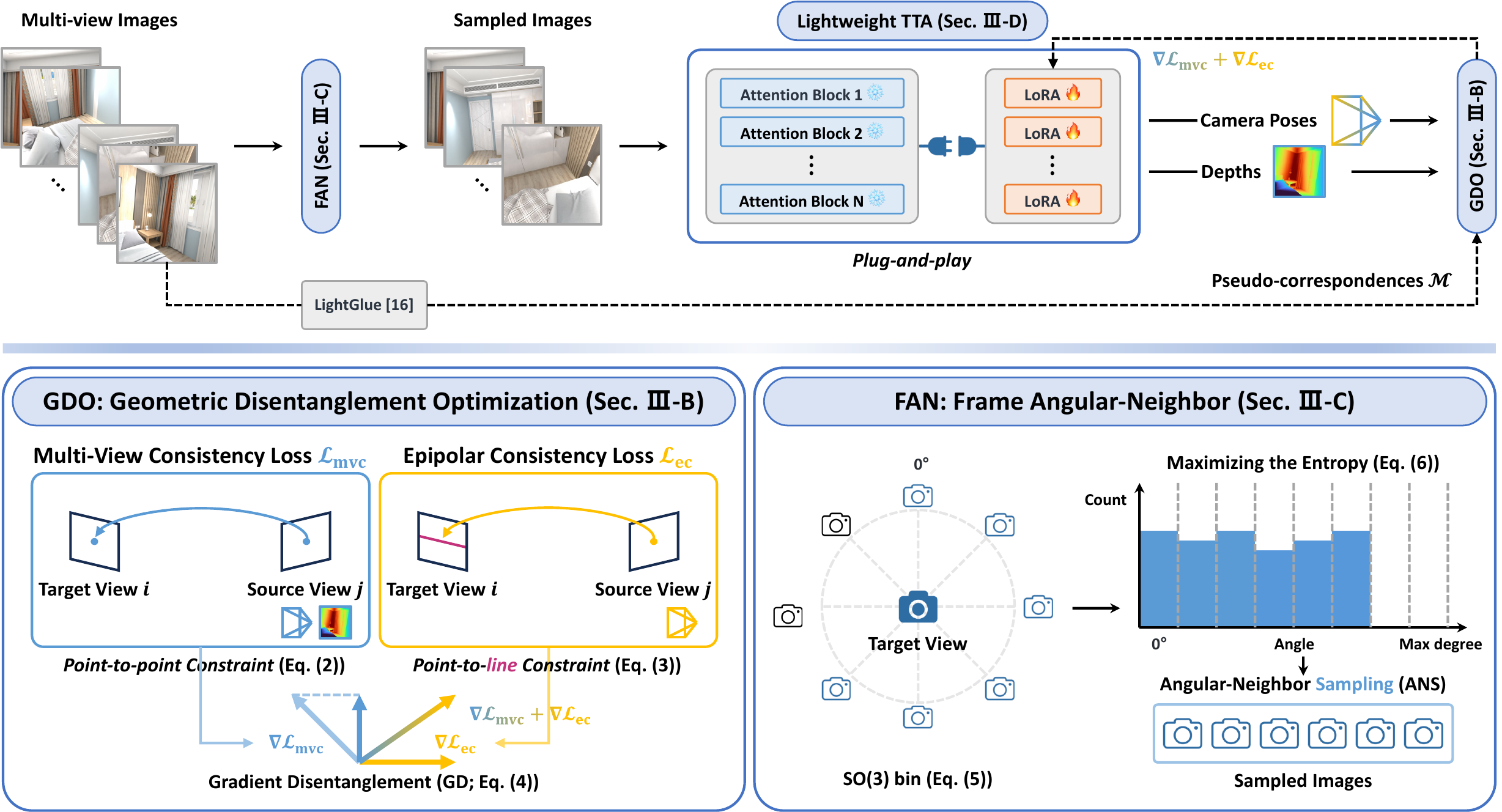
Self-Geometry adapts a frozen pretrained VFM to a target scene through three
complementary components: GDO, FAN, and
Lightweight TTA.
Fig. 3. Overview of our proposed Self-Geometry pipeline.
Self-Geometry adapts a frozen pretrained VFM to a target scene through three
complementary components. (i) GDO formulates two GT-free correspondence-guided
losses (point-to-point MVC Loss and point-to-line EC Loss) and applies
Gradient Disentanglement (GD) to prevent the gradient conflict that can arise
between them. (ii) FAN samples angularly diverse views via
scene-scale-invariant SO(3) geodesic distances. (iii) Lightweight TTA
updates only LoRA parameters inserted into the attention blocks of the pretrained VFM.
GDO Geometric Disentanglement Optimization
Combines the point-to-point MVC Loss (supervises pose & depth jointly)
and the depth-independent point-to-line EC Loss (supervises pose alone),
then applies Gradient Disentanglement to prevent the gradient conflict
that can arise between the two losses on the camera poses.
FAN Frame Angular-Neighbor
An SO(3)-guided view sampler that selects the target view maximizing
SO(3)-bin entropy (Geometry-Rich View Selection) using
scene-scale-invariant SO(3) geodesic distances, achieving uniform scene coverage.
Lightweight TTA LoRA-based Per-Scene Adaptation
Inserts LoRA only into the QKV weights of the pretrained VFM's attention
blocks. The pretrained parameters remain frozen and only LoRA is updated, completing
per-scene adaptation within two minutes on a single NVIDIA RTX PRO 6000.
Quantitative Results
Pose & Geometry Estimation
Across six pretrained VFMs (VGGT, π3, DA3-Giant/Large/Base/Small) and four benchmarks
(7Scenes, ETH3D, ScanNet++, HiRoom), our proposed Self-Geometry outperforms
Free-Geometry and TCO on most Mean columns and achieves the largest Mean
improvements over the frozen baselines in both Pose and Geometry Estimation.
Method
7Scenes
ETH3D
ScanNet++
HiRoom
Mean
AUC@3 ↑
AUC@30 ↑
AUC@3 ↑
AUC@30 ↑
AUC@3 ↑
AUC@30 ↑
AUC@3 ↑
AUC@30 ↑
AUC@3 ↑
AUC@30 ↑
VGGT
VGGT
0.25
0.86
0.20
0.76
0.56
0.94
0.51
0.88
0.38
0.86
VGGT-TCO
0.26 +4.3%
0.86 +0.3%
0.17 -12.2%
0.72 -5.4%
0.43 -21.9%
0.92 -1.7%
0.42 -18.4%
0.86 -1.7%
0.32 -15.2%
0.84 -2.0%
VGGT-Fr
0.25 -0.2%
0.86 0.0%
0.20 +3.9%
0.77 +1.1%
0.56 +0.1%
0.94 0.0%
0.54 +4.8%
0.89 +1.8%
0.39 +2.1%
0.86 +0.7%
VGGT-Ours
0.28 +13.9%
0.87 +1.1%
0.27 +37.3%
0.83 +9.2%
0.54 -2.9%
0.94 0.0%
0.47 -8.2%
0.85 -3.4%
0.39 +3.3%
0.87 +1.4%
π3
π3
0.26
0.86
0.33
0.86
0.55
0.94
0.65
0.94
0.45
0.90
π3-TCO
0.02 -90.5%
0.42 -51.3%
0.09 -72.0%
0.60 -30.2%
0.02 -96.0%
0.63 -32.5%
0.01 -97.8%
0.51 -46.1%
0.04 -91.5%
0.54 -40.0%
π3-Fr
0.26 -0.3%
0.86 0.0%
0.32 -3.4%
0.85 -0.1%
0.45 -18.4%
0.93 -1.3%
0.63 -2.1%
0.95 +0.6%
0.41 -7.1%
0.90 -0.2%
π3-Ours
0.26 -1.5%
0.86 +0.3%
0.41 +25.1%
0.90 +5.0%
0.60 +8.8%
0.95 +1.6%
0.67 +3.4%
0.95 +0.8%
0.48 +8.3%
0.92 +1.9%
DA3-Giant
DA3-G
0.27
0.87
0.49
0.91
0.85
0.98
0.80
0.96
0.60
0.93
DA3-G-TCO
0.28 +1.6%
0.87 +0.1%
0.50 +2.5%
0.92 +1.0%
0.84 -1.3%
0.98 -0.2%
0.81 +1.6%
0.96 +0.1%
0.61 +0.8%
0.93 +0.2%
DA3-G-Fr
0.28 +0.8%
0.87 +0.1%
0.52 +7.9%
0.92 +1.1%
0.85 +0.2%
0.98 0.0%
0.82 +1.9%
0.98 +1.7%
0.62 +2.4%
0.94 +0.7%
DA3-G-Ours
0.27 0.0%
0.87 0.0%
0.50 +3.4%
0.91 -0.2%
0.84 -1.0%
0.98 -0.1%
0.83 +3.5%
0.96 +0.4%
0.61 +1.5%
0.93 +0.1%
DA3-Large
DA3-L
0.29
0.86
0.32
0.87
0.56
0.94
0.59
0.94
0.44
0.90
DA3-L-TCO
0.30 +2.6%
0.86 +0.1%
0.31 -3.7%
0.87 -0.2%
0.54 -2.9%
0.94 -0.3%
0.62 +5.0%
0.95 +0.6%
0.44 +0.5%
0.90 +0.1%
DA3-L-Fr
0.29 +0.4%
0.86 -0.1%
0.36 +13.3%
0.88 +1.6%
0.56 +0.9%
0.94 +0.1%
0.58 -1.0%
0.94 +0.1%
0.45 +2.5%
0.91 +0.4%
DA3-L-Ours
0.29 -0.3%
0.86 -0.1%
0.32 -1.5%
0.87 -0.2%
0.56 0.0%
0.94 0.0%
0.62 +5.6%
0.94 +0.4%
0.45 +1.6%
0.90 0.0%
DA3-Base
DA3-B
0.21
0.82
0.15
0.75
0.20
0.81
0.19
0.83
0.19
0.80
DA3-B-TCO
0.22 +1.0%
0.83 +0.7%
0.16 +5.0%
0.76 +1.4%
0.20 +0.8%
0.81 -0.4%
0.20 +3.9%
0.84 +0.6%
0.19 +2.5%
0.81 +0.6%
DA3-B-Fr
0.21 -2.0%
0.82 -0.2%
0.18 +19.9%
0.77 +2.9%
0.21 +1.7%
0.81 +0.8%
0.17 -12.3%
0.83 -0.8%
0.19 +0.8%
0.81 +0.6%
DA3-B-Ours
0.22 +1.2%
0.83 +0.4%
0.16 +9.8%
0.75 +0.9%
0.21 +2.2%
0.81 +0.2%
0.29 +54.8%
0.87 +4.4%
0.22 +16.6%
0.81 +1.5%
DA3-Small
DA3-S
0.15
0.78
0.09
0.62
0.09
0.68
0.09
0.75
0.10
0.71
DA3-S-TCO
0.15 +5.6%
0.79 +0.4%
0.09 +2.4%
0.62 -0.3%
0.08 -9.0%
0.66 -3.1%
0.10 +4.4%
0.76 +0.9%
0.11 +1.5%
0.71 -0.5%
DA3-S-Fr
0.15 +2.4%
0.78 0.0%
0.10 +19.5%
0.66 +6.4%
0.09 +1.9%
0.70 +1.9%
0.09 -5.6%
0.74 -1.3%
0.11 +4.0%
0.72 +1.5%
DA3-S-Ours
0.14 -2.4%
0.79 +1.0%
0.09 +8.3%
0.64 +3.6%
0.09 0.0%
0.69 +0.3%
0.16 +64.8%
0.79 +5.6%
0.12 +15.6%
0.73 +2.6%
Table II. Pose Estimation results (AUC@3, AUC@30 ↑) on 7Scenes, ETH3D,
ScanNet++, HiRoom, and Mean. Each pretrained model appears in four consecutive rows: the
baseline and three adapted variants with suffix “-TCO”
(TCO), “-Fr” (Free-Geometry), and
“-Ours” (Self-Geometry).
Δ% vs. baseline in parentheses; green = gain,
red = degradation.
Method
7Scenes
ETH3D
ScanNet++
HiRoom
Mean
w/o p. ↑
w/ p. ↑
w/o p. ↑
w/ p. ↑
w/o p. ↑
w/ p. ↑
w/o p. ↑
w/ p. ↑
w/o p. ↑
w/ p. ↑
VGGT
VGGT
0.43
0.37
0.52
0.43
0.60
0.40
0.60
0.68
0.54
0.47
VGGT-TCO
0.44 +3.1%
0.39 +4.9%
0.49 -4.6%
0.40 -7.9%
0.48 -19.8%
0.36 -10.1%
0.44 -26.5%
0.51 -24.8%
0.46 -13.4%
0.41 -12.0%
VGGT-Fr
0.43 +0.4%
0.37 +1.1%
0.50 -4.3%
0.44 +1.1%
0.59 -1.0%
0.41 +1.2%
0.63 +6.0%
0.67 -0.6%
0.54 +0.4%
0.47 +0.5%
VGGT-Ours
0.44 +3.3%
0.38 +4.6%
0.60 +16.5%
0.47 +9.3%
0.54 -10.6%
0.41 +2.5%
0.55 -7.5%
0.64 -4.9%
0.53 -0.4%
0.48 +1.8%
π3
π3
0.42
0.58
0.70
0.79
0.63
0.77
0.74
0.83
0.62
0.74
π3-TCO
0.17 -60.1%
0.15 -75.0%
0.48 -31.5%
0.44 -44.3%
0.24 -62.1%
0.34 -55.8%
0.11 -84.9%
0.15 -81.6%
0.25 -60.0%
0.27 -63.7%
π3-Fr
0.43 +3.1%
0.58 +0.5%
0.71 +1.0%
0.80 +0.2%
0.51 -19.6%
0.77 +0.1%
0.62 -17.1%
0.81 -2.6%
0.56 -9.3%
0.74 -0.6%
π3-Ours
0.46 +10.5%
0.57 -1.0%
0.74 +5.9%
0.81 +2.6%
0.65 +2.2%
0.79 +3.4%
0.77 +3.8%
0.84 +1.3%
0.65 +5.1%
0.76 +1.7%
DA3-Giant
DA3-G
0.49
0.56
0.79
0.87
0.78
0.80
0.86
0.95
0.73
0.80
DA3-G-TCO
0.51 +3.1%
0.59 +5.5%
0.79 +0.3%
0.87 +0.1%
0.76 -2.8%
0.80 -0.1%
0.84 -2.0%
0.94 -1.3%
0.73 -0.7%
0.80 +0.6%
DA3-G-Fr
0.51 +2.2%
0.56 -0.9%
0.79 +0.6%
0.87 -0.7%
0.78 -0.1%
0.80 0.0%
0.86 +0.7%
0.94 -1.4%
0.74 +0.7%
0.79 -0.8%
DA3-G-Ours
0.51 +2.8%
0.57 +1.5%
0.78 -0.2%
0.87 +0.1%
0.79 +0.4%
0.81 +0.5%
0.87 +1.2%
0.95 -0.5%
0.74 +0.9%
0.80 +0.3%
DA3-Large
DA3-L
0.51
0.48
0.69
0.75
0.69
0.76
0.69
0.88
0.65
0.72
DA3-L-TCO
0.51 -0.7%
0.48 +1.3%
0.68 -1.4%
0.75 0.0%
0.65 -5.5%
0.76 -0.9%
0.74 +7.5%
0.83 -5.2%
0.65 0.0%
0.71 -1.6%
DA3-L-Fr
0.53 +3.5%
0.48 -0.5%
0.68 -2.7%
0.76 +0.8%
0.69 +0.6%
0.76 0.0%
0.57 -17.3%
0.77 -12.5%
0.62 -4.5%
0.69 -3.7%
DA3-L-Ours
0.51 +0.4%
0.47 -1.3%
0.69 -1.1%
0.75 +0.1%
0.69 +0.5%
0.76 +0.1%
0.72 +4.3%
0.88 -0.1%
0.65 +1.1%
0.72 -0.2%
DA3-Base
DA3-B
0.50
0.50
0.49
0.66
0.48
0.67
0.23
0.72
0.42
0.64
DA3-B-TCO
0.48 -3.8%
0.51 +2.6%
0.49 -0.2%
0.68 +2.7%
0.44 -7.5%
0.67 -0.1%
0.26 +11.3%
0.65 -9.7%
0.42 -1.8%
0.63 -1.5%
DA3-B-Fr
0.49 -2.0%
0.50 -0.5%
0.50 +1.3%
0.66 -0.2%
0.48 +1.2%
0.68 +0.5%
0.19 -18.4%
0.68 -5.4%
0.41 -2.4%
0.63 -1.5%
DA3-B-Ours
0.50 +0.2%
0.50 -0.8%
0.50 +1.9%
0.67 +0.8%
0.48 +0.2%
0.67 +0.3%
0.43 +85.2%
0.72 +0.4%
0.48 +12.2%
0.64 +0.3%
DA3-Small
DA3-S
0.39
0.47
0.37
0.64
0.33
0.53
0.18
0.51
0.32
0.54
DA3-S-TCO
0.39 -1.1%
0.47 +0.7%
0.38 +2.0%
0.66 +3.1%
0.30 -7.9%
0.53 -0.9%
0.21 +13.8%
0.42 -17.6%
0.32 +0.2%
0.52 -3.4%
DA3-S-Fr
0.41 +4.5%
0.47 -0.1%
0.49 +31.5%
0.64 +1.3%
0.33 +0.8%
0.53 -0.2%
0.16 -12.1%
0.51 -0.8%
0.35 +9.1%
0.54 +0.1%
DA3-S-Ours
0.38 -2.1%
0.47 +1.4%
0.41 +11.0%
0.65 +2.1%
0.34 +4.4%
0.53 +0.4%
0.31 +70.4%
0.55 +7.0%
0.36 +13.9%
0.55 +2.7%
Table III. Geometry Estimation results (F1-score ↑) under unposed
(w/o p.) and posed (w/ p.) modes on the same four benchmarks.
Same row layout as Table II.
Qualitative Comparison
Side-by-Side with Prior TTA
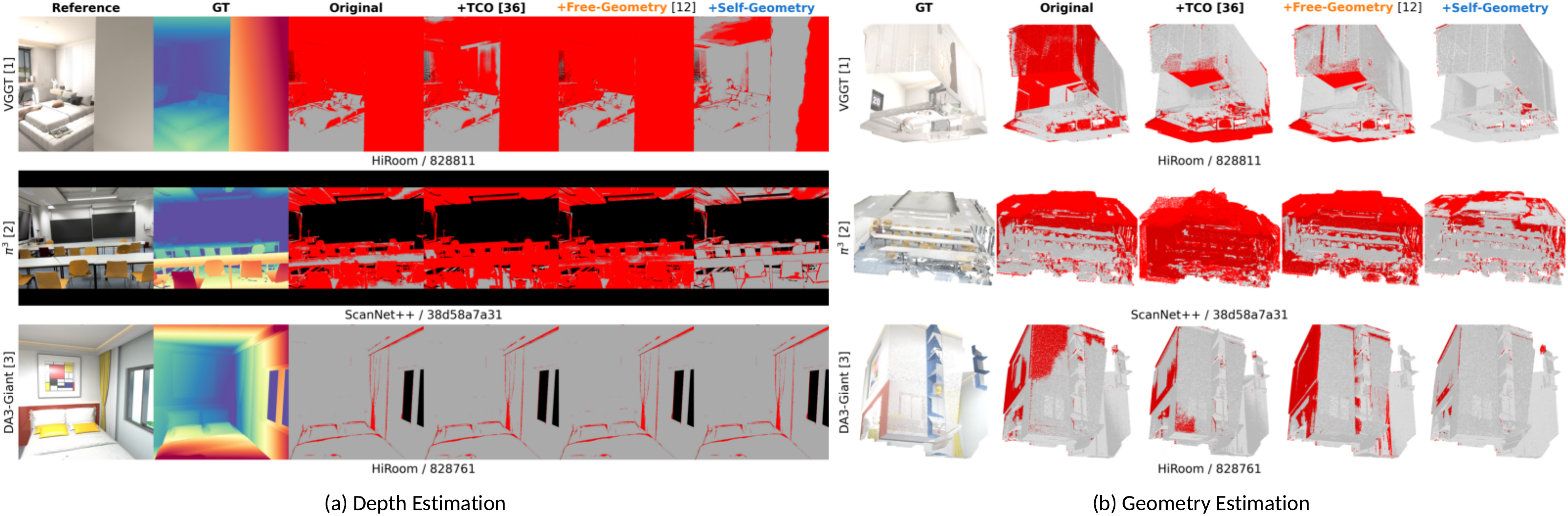
Static side-by-side comparison across representative scenes. Compared with Original,
TCO, and Free-Geometry, our proposed Self-Geometry substantially
reduces error regions in both depth error maps and fused pointclouds.
Fig. 4. Qualitative comparison of pretrained VFMs against our proposed
Self-Geometry across representative scenes (rows: VGGT, π3, DA3-Giant).
(a) Depth Estimation: Reference RGB, GT depth, and depth error maps for Original,
+TCO, +Free-Geometry, and +Self-Geometry (Ours).
(b) Geometry Estimation: GT fused pointcloud and geometry error maps for the
same four methods. Red = errors above threshold;
gray = correctly reconstructed pixels.
Cite
BibTeX
@article{youn2026selfgeometry,
  title   = {Self-Geometry: GT-Free and Plug-and-Play Test-Time Adaptation
             for Geometrically Consistent 3D Vision Foundation Models},
  author  = {Seokhyun Youn and Dahyeon Kye and Sung-Ho Bae and Jihyong Oh},
  journal = {arXiv preprint arXiv:2608.10708},
  year    = {2026}
}

 Creative Vision and Multimedia Lab (CMLab),
  Chung-Ang University, South Korea
 Efficient Neural Computing Lab (ENC Lab),
  Kyung Hee University, South Korea